
How to Talk About Money as a Couple

Discussing money with a partner can be one of the most challenging and crucial conversations in a relationship. Money is rarely just about pounds and pence; it’s deeply intertwined with our emotions, values, fears, power, and life experiences. This makes it a topic that can either unite a couple around shared goals or pull them apart with stress and resentment.
Financial disagreements are consistently cited as a leading cause of relationship stress and a significant factor in break-ups and divorces. However, the opposite is also true. When approached with openness, empathy, and a plan, these conversations can build profound trust, security, and a sense of true partnership.
Many couples avoid the topic, operating on vague assumptions until a problem—an unexpected bill, a hidden debt, or a difference in spending habits—forces the issue, often in the most confrontational way possible.
This guide isn’t just about how to create a budget. It’s about how to unpack your “money mindset,” communicate your values and fears, and build a system that works for both of you. We explore strategies to navigate these discussions constructively, turning money from a source of division into a tool for building your dreams together.
Preparing to Discuss Money Openly
Before you dive into a money conversation, preparation is essential. Storming in unannounced during an argument over a credit card bill is a recipe for disaster. Successful preparation has two components: internal prep (with yourself) and external prep (with your partner).
1. Understand Your Own “Money Mindset”
First, you must understand your own financial situation. Gather the facts: your income, debts, savings, and general spending habits. But this is only half the battle.
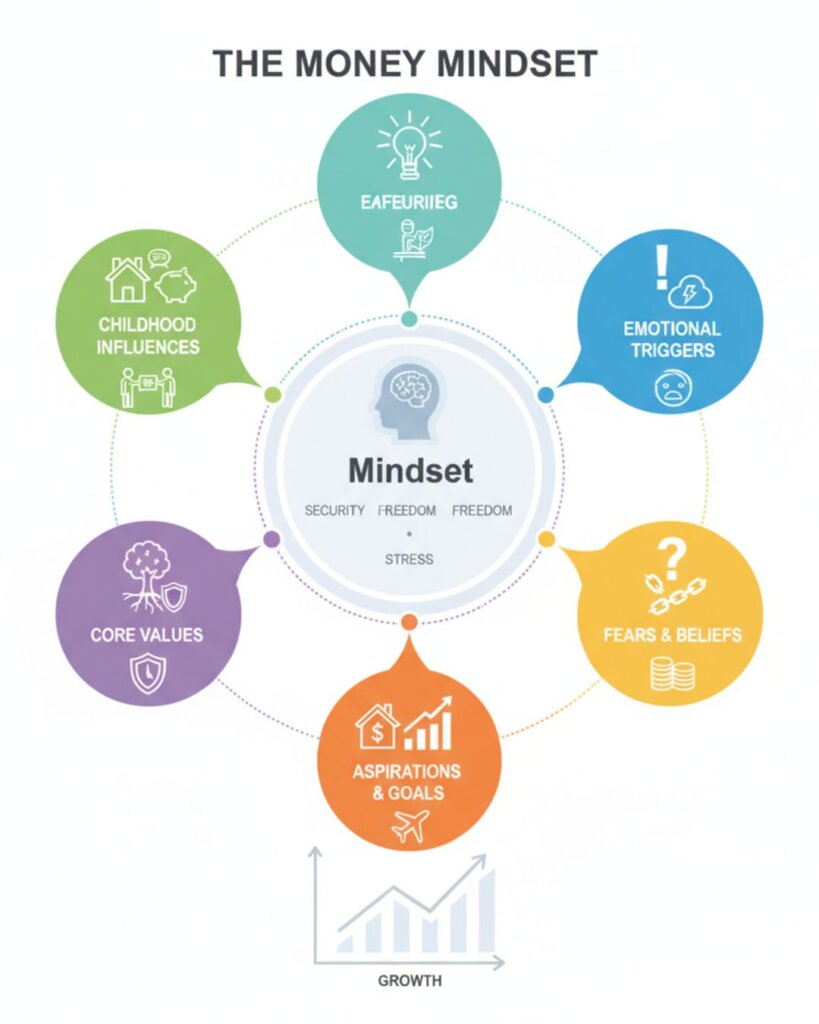
Equally important is reflecting on your personal “money mindset.” This is your unique set of beliefs, emotions, and attitudes towards money, often formed in childhood. Ask yourself:
- How do you view money? Is it a source of security? A means to freedom? A tool for status? Or a constant source of stress and anxiety?
- What fears or beliefs do you hold? Do you believe money is scarce and must be hoarded (a scarcity mindset)? Or that there will always be more (an abundance mindset)?
- What are your emotional triggers? Do you feel anxious when your current account dips below a certain number? Do you feel guilty spending money on yourself? Do you get defensive when someone questions a purchase?
- What did you learn about money growing up? Did your parents fight about money? Was money a taboo topic? Did your family live paycheque-to-paycheque, or were they financially secure?
Without this self-awareness, it’s almost impossible to have a calm conversation. If you don’t know why you feel panicked by an expensive restaurant bill, you will simply react with anger or fear, rather than being able to articulate, “I feel anxious because spending that much on food makes me feel like we’re being reckless.”
2. Setting the Stage: The “Money Date”
Choosing the right moment is critical. Never start a serious money talk:
- During an existing argument.
- When one of you is tired, hungry, or stressed from work.
- In public.
- Right before bed.
Instead, schedule a “money date.” Frame it as a positive, no-pressure event. You could say: “I know talking about money can be stressful, but it’s really important to me that we’re on the same page and working as a team. Can we set aside an hour on Saturday morning to grab a coffee and review our finances?”
Establish Ground Rules for Mutual Respect:
- No Blame, No Shame: Agree that this is a judgement-free zone. The goal is to understand, not to accuse.
- Full Transparency: You both agree to be completely honest about debts, savings, and spending habits.
- Focus on the Future: While the past informs your habits, the point of the conversation is to build a shared future.
- It’s OK to Pause: If the conversation gets too heated, agree to take a 20-minute break and come back when you’re both calm.
Aligning Financial Values and Goals
Once you’ve prepared, the next step is to understand each other’s values. The biggest money arguments are rarely about the numbers; they’re about misaligned values. One person spends £200 on a fancy dinner because they value experiences, while the other is furious because that £200 could have gone into the emergency fund, which they value as security. Neither is “wrong,” but they value different things.
Start by discussing your financial histories:
- “What’s your earliest memory of money?”
- “What role did money play in your childhood?”
- “What does ‘financial security’ mean to you?”
- “What does ‘financial freedom’ mean to you?”
Expert Tip: Many couples find their arguments aren’t about the money itself, but about what the money represents—security, trust, fairness, power, or love. The relationship charity Relate offers resources for navigating these deeper disagreements. See relationship guidance at Relate.org.uk
Dealing with “Financial Opposites”
It’s common for the “saver” to be attracted to the “spender.” At first, it can feel like a balance. But long-term, it can cause immense friction. If you are financial opposites, don’t panic.
Instead of focusing on the habits (saving vs. spending), focus on the underlying values. The spender may not be irresponsible; they may simply value generosity and living in the moment. The saver may not be stingy; they may value security and stability.
The goal is to find common ground. “I understand that security is most important to you, and you understand that experiences are important to me. How can we create a plan that honours both? Perhaps we can automate our security savings first, and what’s left over can be allocated for experiences we both enjoy?”
From Values to Action: Defining Your Shared Goals
Once you understand each other’s values, you can create shared goals. This turns the “budget” from a restrictive straitjacket into a tool for achieving your dreams. Document this shared vision.
- Short-Term Goals (Next 1-2 years): E.g., Build a 3-month emergency fund, pay off a specific credit card, save for a holiday.
- Mid-Term Goals (Next 2-5 years): E.g., Save for a house deposit, buy a new car, take a big trip.
- Long-Term Goals (5+ years): E.g., Achieve financial independence, pay off the mortgage, plan for retirement (What does that look like for each of you?).
This document becomes your North Star. When a conflict over a purchase comes up, you can refer back to it: “Does this purchase move us closer to, or further from, our goal of buying a home?”
Discussing Income, Expenses, and Debt Transparently
This is the practical part. Choose a comfortable setting and approach the topic with curiosity, not judgement. Full transparency is the only rule.
- Build a Budget Together: This is your game plan. Start by listing all income sources. Then, list all expenses—fixed (mortgage/rent, utilities, council tax) and variable (groceries, going out, shopping). Use a tool that works for you (a spreadsheet, a budgeting app). The act of building it together fosters teamwork and mutual ownership.
- Manage Debts Openly: This is the biggest trust-breaker. You must disclose all liabilities—credit cards, student loans, car loans, or other obligations. Hiding debt is a form of financial infidelity. It causes far deeper wounds than the debt itself.
- Create a Repayment Plan: If there is debt, create a plan of attack together. Will you use the “snowball” method (pay off smallest debts first for quick wins) or the “avalanche” method (pay off highest-interest debts first to save money)? The method you choose matters less than the agreement to do it together.
Transparency builds trust and allows for mutual accountability. If there are income differences, aim for contributions that feel fair and proportional, not necessarily “equal.” If one person earns £60,000 and the other £30,000, a 50/50 split of the bills is not fair. A proportional split (e.g., 66%/33%) may feel more equitable and prevent resentment.
Choosing a System: Joint vs. Separate Accounts
There is no single “right” way to combine finances. The best system is the one you both agree on. Here are the common models:
| Banking Method | How It Works | Pros | Cons |
|---|---|---|---|
| 1. All-In Joint Account | All income from both partners goes into one shared account. All bills and spending come out of this account. | Full transparency; simple to manage; fosters a strong “one team” mentality. | Loss of personal autonomy; can cause friction if spending habits differ; harder to buy gifts. |
| 2. “Yours, Mine, Ours” | You keep your separate personal accounts and also open a new joint account for shared expenses (e.g., mortgage, bills, groceries). | Balances autonomy with teamwork; each person has personal spending money; clear responsibility for shared bills. | Requires more admin (3+ accounts); must agree on how much each person contributes to the joint pot. |
| 3. Completely Separate | You keep all your finances separate. You decide who pays for which bills (e.g., “You pay the mortgage, I’ll pay for utilities and food”). | Maximum personal autonomy; easy to manage if you have very different financial styles. | Lacks transparency; hard to build shared goals; can lead to imbalance and resentment. |
Government Guidance: For free, impartial advice on building a joint budget or handling joint debts, the UK’s MoneyHelper service provides clear, actionable steps for couples.
Get the MoneyHelper guide to talking about money
Managing Financial Conflicts with Empathy
Disagreements will happen. The goal is not to avoid conflict, but to manage it constructively. When disagreements arise, use communication techniques rooted in empathy:
- Active Listening: Truly hear your partner without just preparing your defensive response. Try to understand the emotion behind the words. “What I’m hearing you say is that you feel insecure when I spend money without talking to you first. Is that right?”
- Avoid Blame: Do not use “You always…” or “You never…” statements. They instantly put the other person on the defensive.
- Use “I” Statements: Talk about your feelings.
- Instead of: “You spend way too much money on stupid things!”
- Try: “I feel anxious and stressed when I see large credit card charges we didn’t discuss, because I worry about our goal of saving for a house deposit.”
Compromise is essential. Consider setting mutually acceptable boundaries. One of the most effective tools is a “fun money” allowance for each partner—a set amount of money each person gets to spend per month, no questions asked, no judgement. This gives both of you autonomy and freedom while keeping the main budget intact.
If conflicts become entrenched and you have the same arguments repeatedly, seek professional guidance. A financial counsellor or a couples’ therapist can provide a neutral path forward.
Building a Sustainable Financial Plan Together
A sustainable plan requires collaboration and flexibility. It is not a “set it and forget it” document. It should include:
- A Joint Budget: A realistic plan that accounts for shared and individual expenses (using one of the systems from the table above).
- An Emergency Fund: This is your buffer against life’s stress. Agree on a target (e.g., 3-6 months of essential expenses) and a regular contribution plan. Having this fund stops a broken car from turning into a massive money argument.
- Investment & Retirement Planning: Discuss your risk tolerance. Are you both comfortable with stock market investments, or does one prefer safer options? More importantly, align your retirement visions. Does one want to travel the world while the other wants to retire early and live in a quiet cottage? These visions need to be aligned.
- Legal Considerations: Understand how your finances are legally linked. This is especially crucial if you are not married but share assets. Do you have wills? Lasting Powers of Attorney? Understanding liability for joint debts is vital.
Know Your Rights: It is crucial to understand the legal implications of joint finances, especially regarding debt. Citizens Advice provides vital, free information on liability for joint accounts and debts.
Finally, schedule regular check-ins. Your financial plan needs to evolve with your life. Review your plan and budget quarterly or semi-annually, or whenever a big life change happens (a new job, a baby, a house move). This ongoing dialogue is the true key to long-term financial harmony.
Conclusion
Open and honest communication about money isn’t just a “nice-to-have”—it’s a vital component of a healthy, lasting relationship. It may feel intimidating, but avoiding the topic only guarantees that problems will grow.
By preparing thoroughly, focusing on your own mindset first, you can approach the conversation calmly. By aligning your values before you debate the numbers, you ensure you’re working towards the same dreams. By discussing the facts transparently and managing the inevitable conflicts with empathy, you build trust.
And finally, by building a sustainable plan together and revisiting it regularly, you transform money from a scary taboo into a powerful tool. An open, ongoing financial dialogue strengthens both your financial and emotional bonds, reduces anxiety, and empowers you to achieve your shared aspirations as a true team.
About the author

I hold degrees in Law and Marketing, and I work with strategic content creation, branding, and social media. I'm passionate about finance and communication, and I enjoy turning complex topics into clear, useful, and accessible information. I'm communicative and organised, with a strong interest in fashion and great shopping. In my free time, I love being in nature, cooking, travelling, and diving into content that inspires me to keep learning.


